Mastering the Spring Bird House Silhouette Vector for Professional Design
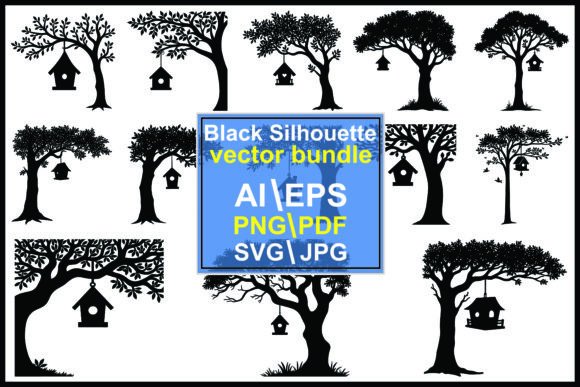
In the world of digital illustration and graphic design, finding assets that balance aesthetic appeal with technical versatility is often a challenge. The Spring Bird House Silhouette Vector collection represents a prime example of how simple, clean design elements can elevate a project from amateur to professional. These graphics, featuring black silhouettes of birdhouses hanging from leafy branches, are not merely decorative; they are functional tools for creators who understand the importance of scalability and clarity. Whether you are designing for a rural countryside brand, a wildlife conservation campaign, or seasonal garden decor, understanding how to properly utilize these vectors is essential for achieving high-quality results.
Understanding the Versatility of Silhouette Assets
A silhouette vector bundle is more than just a black-and-white image. It is a conceptual representation of nature, outdoor living, and avian shelter. The stark contrast between the black shape and the white background creates a minimal, artistic look that fits seamlessly into various design contexts. Because these illustrations are isolated cutouts, they serve as flexible design elements that can be layered, resized, and recolored without losing integrity. This makes them ideal for applications ranging from wedding invitations and greeting cards to large-format signage and website headers.
However, many users overlook the specific advantages of having access to multiple file formats within a single bundle. A comprehensive package typically includes JPG, PNG, AI, EPS, SVG, and PDF files, all compressed into one zip archive. This variety ensures that regardless of your software preference or output requirement, you have the right tool for the job. Ignoring this diversity often leads to unnecessary workflow bottlenecks.
Common Mistakes in File Selection and Usage
One of the most frequent errors designers make is choosing the wrong file format for their intended medium. For instance, using a raster image like a JPG or PNG for a large-scale print project can result in pixelation and blurred edges. Raster files are composed of pixels, meaning they have a fixed resolution. When you enlarge them beyond their original dimensions, the quality degrades significantly. This is particularly problematic for silhouette designs, where crisp, clean lines are paramount to the visual impact.
Conversely, vector files such as AI, EPS, and SVG are mathematically defined paths. They can be scaled infinitely without any loss of quality. If you are creating a billboard advertisement or a small business card, the same vector file will render perfectly in both instances. Failing to recognize this distinction can lead to costly reprints and dissatisfied clients. Always verify the output size before selecting your file type. For web use, SVGs are often superior due to their small file size and scalability on responsive screens, while PNGs are better suited for transparent backgrounds in digital composites.
The Pitfall of Ignoring Layer Structure
Another common misunderstanding involves the editing capabilities of different formats. Beginners often download an EPS or AI file and struggle to edit individual components because they do not understand how to handle grouped objects. In a well-constructed vector bundle, elements like the birdhouse, the branch, and the leaves may be grouped for convenience. However, to change the color of just the birdhouse or to remove the leaves for a simpler look, you must ungroup these elements. Neglecting to learn basic vector manipulation techniques limits the utility of the asset. Take the time to explore the layer panel in your design software. Unlocking these layers allows for greater creative freedom and customization.
Evaluating Quality and Usability
When acquiring a Spring Bird House Silhouette Vector bundle, it is crucial to assess the quality of the paths. Poorly constructed vectors may contain unnecessary anchor points, resulting in jagged curves or complex file structures that slow down your design software. High-quality illustrations should have smooth, organic curves that accurately reflect the natural shapes of branches and leaves. Before committing to a purchase or extensive use, open the AI or EPS file and zoom in closely. Check the edges for smoothness and ensure that the silhouette is a single, closed path if you intend to use it for cutting machines or vinyl decals.
Additionally, consider the semantic relevance of the design. A birdhouse hanging from a leafy branch evokes feelings of spring, summer, and nurturing. It suggests themes of home, shelter, and wildlife. If your project aims to convey a sense of winter or austerity, this specific imagery might require modification or contextual adjustment. Aligning the visual metaphor with your message is key to effective communication. Do not force a spring-themed graphic into a winter campaign without considering how the leafy branches might contradict the seasonal narrative.
Practical Advice for Extraction and Organization
Technical hurdles often arise at the very beginning of the process: extracting the files. The bundle is typically delivered as a compressed zip file containing all formats. Users sometimes attempt to open files directly from within the zip archive without extracting them first. This can lead to corrupted data or inability to save changes. Always use reliable extraction tools like WinZip, WinRAR, or the built-in extraction features of your operating system. Double-click the zip file and extract the contents to a dedicated folder on your hard drive. This ensures that all linked assets and font references (if any) remain intact and accessible.
Organizing your assets efficiently is also part of professional practice. Create a standardized folder structure for your design resources. Separate vectors by theme or season. This saves time when you need to locate specific elements for future projects. Treating your digital library with care enhances your overall efficiency and reduces the stress of last-minute searches.
Maximizing Creative Potential
To truly leverage the value of these illustrations, think beyond the default black-and-white presentation. While the classic silhouette is powerful, changing the color palette can adapt the image to different brands or moods. A soft pastel green might suit a baby shower invitation, while a deep navy blue could work for a corporate eco-friendly report. Experiment with opacity and blending modes to integrate the birdhouse into photographic backgrounds. The simplicity of the design allows it to act as a subtle texture or a bold focal point, depending on your arrangement.
Furthermore, consider the compositional balance. When placing the birdhouse on a page, respect the negative space. The isolation of the element means it carries visual weight. Ensure there is enough breathing room around the silhouette to let it stand out. Cluttering the design with too many additional elements can diminish the impact of the clean, minimal aesthetic.
Final Considerations for Decision Making
Before finalizing your choice of assets, review the licensing terms. Most bundles allow for personal and commercial use, but it is always wise to confirm this to avoid legal issues. Understanding the scope of usage rights protects your business and ensures ethical practices. Additionally, check for customer support or updates from the creator. A responsive designer often provides valuable tips or fixes for any minor issues that may arise.
In conclusion, the Spring Bird House Silhouette Vector is a versatile and powerful resource for any designer. By avoiding common mistakes in file selection, understanding the technical nuances of vector graphics, and applying thoughtful creative strategies, you can enhance the quality and effectiveness of your projects. Embrace the simplicity and elegance of these organic design elements, and let them inspire your next creative endeavor.